

A slow storefront never throws an error.
Nothing crashes. Nothing pages anyone. The theme looks great, the dashboard fills in on schedule, and the money leaves anyway.
For a long time we treated speed as polish. The thing you fix in the last sprint, once the catalog is clean and the theme behaves. When a storefront converted badly, we blamed the catalog first, then the copy. Then we sat down with the actual studies (not the blog-post summaries, the studies themselves) and found out we had spent years interrogating the wrong suspect.
Death by app store
Picture a mid-market store with paid traffic arriving on schedule. Open PageSpeed Insights on an app-heavy storefront and the score lands in the 30s.
Where does the time go? The apps. A typical mid-market Shopify store runs more of them than anyone remembers installing, each injecting its own scripts and network calls into every page load. The chat widget takes its cut. The personalization engine takes another. The loyalty platform waits its turn. Before a visitor sees the homepage, the second is already spent.
Each bill looks tiny on its own. Internally we call the total death by app store.
What one second costs
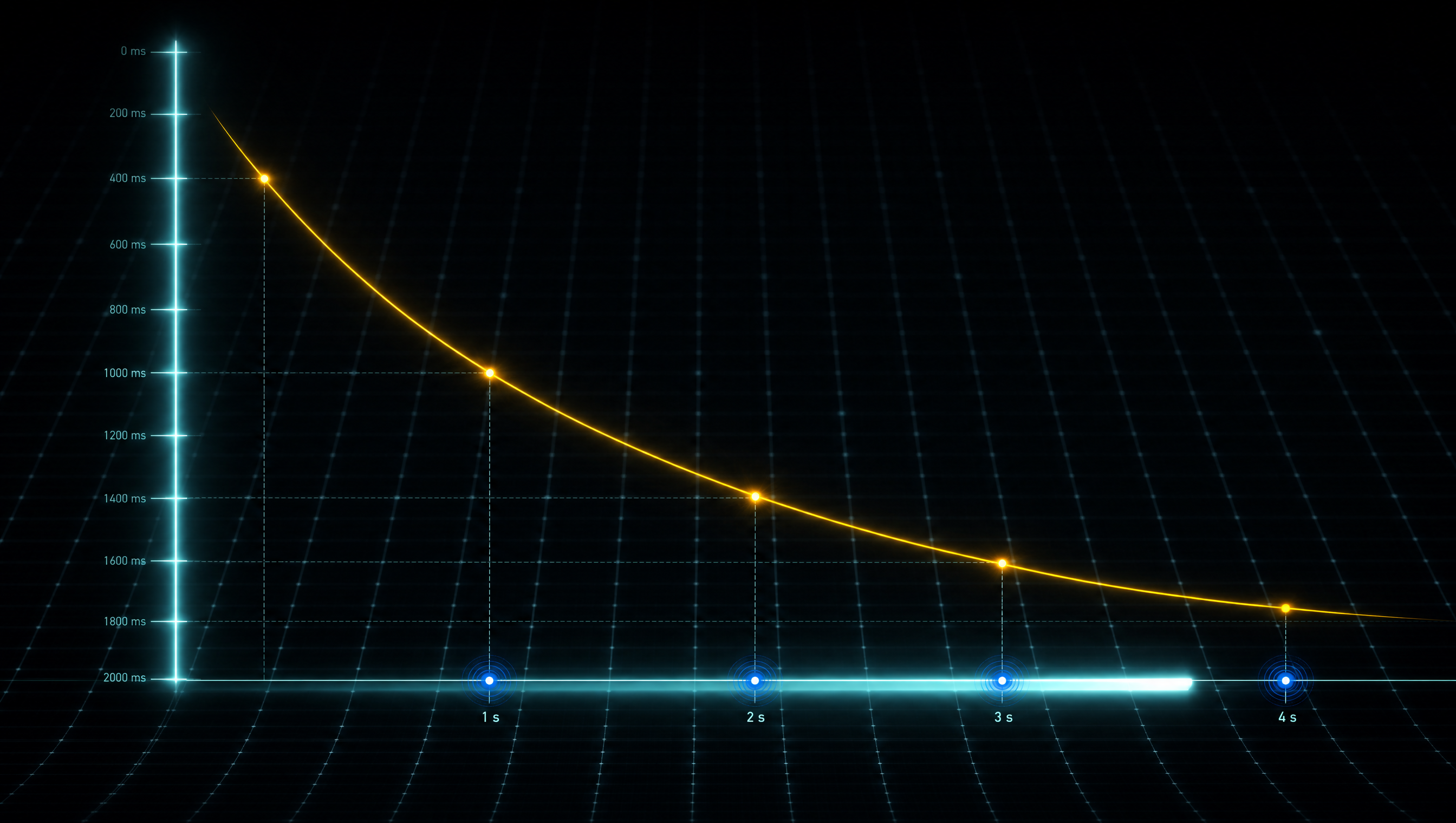
We assumed the waiting was annoying but survivable. Portent measured it, across more than 100 million page views on 20 retail and B2B sites. At a one-second load, e-commerce converts at 3.05%. At two seconds, 1.68%.
One extra second. Nearly half the transactions gone.
And it keeps falling. By the fourth second you're at roughly a fifth of where you started, and the stretch between two and four seconds alone erases 60% of transactions. This runs on every page, all day, on traffic you paid to acquire.

Customers don't file a complaint on the way out. Google tracked the exits instead: move from one second to three and bounce rates jump 32%. Stretch it to five and they jump 90%. On mobile, 53% of visits abandon a page that takes longer than three seconds.
Shoppers will even admit it. A consumer survey quoted in Deloitte's Milliseconds Make Millions report found 70% of consumers saying page speed affects their willingness to buy from an online retailer. The same report cites Google's user performance data on where attention breaks: past one second, users start losing focus on the task in front of them.
That is the entire patience budget.
The tenth of a second
Our mental model finally broke on a much smaller number. We had been thinking in seconds. The studies think in tenths.
Deloitte and Google measured what a 0.1-second improvement did across 37 European and American brand sites, 30 million sessions in a 30-day window. Retail conversion rose 8.4%. Average order value rose 9.2%. One tenth of a second moved both dials.
The oldest number in this genre traces to Amazon in 2006, by way of Greg Linden, an engineer there at the time: in internal A/B tests, every 100 milliseconds of added page load time cost about 1% in revenue. Worth knowing what that actually is. A blog post and a Stanford talk, not a published study. The direction has held up anyway: Vodafone put fresh numbers on it in 2021, when a 31% improvement in Largest Contentful Paint (LCP, Google's metric for when the main content lands) returned 8% more sales.
Milliseconds, it turns out, are the unit of money.
Taking the apps out
So we started treating speed as infrastructure instead of polish. Native Liquid replaces the app-injected scripts. Server-side rendering and caching cut the redundant client-side work. Same store, same functionality, and the score climbs out of the red. This is exactly the work behind Vodafone's 8%: rendering moved server-side, images optimized, nothing glamorous.
Then you run the economics and the room goes quiet. Take the Deloitte retail figure at face value, an 8.4% conversion lift from a tenth of a second, and apply it to a mid-market brand doing $1 million a month. The arithmetic returns roughly a million dollars a year, recovered from milliseconds. Not lost to a competitor, not to a bad product. To a stopwatch.

What we're keeping
Three things survived contact with the data.
Speed is infrastructure with a price tag on every 100 milliseconds. Under 2.5 seconds LCP you're in Google's green zone. By the four-second mark, Portent's curve puts you at roughly a fifth of the transactions you'd see at one second, and most of them left without a sound.
Every installed app pays rent in milliseconds, whether or not it earns them back. Most don't. (We learned this the expensive way, one uninstall at a time.)
And the fix doesn't need to be dramatic to pay. Tenths of a second move revenue. That was the part we resisted longest, and the part the data was most insistent about.
These days, on a new storefront, we check the stopwatch before we check the catalog. A slow store will never tell you it's slow. No crash, no error in the log.
Just less.
If your PageSpeed score sits below 50, an Infrastructure Stress-Test will name the specific apps and scripts eating your milliseconds and put a dollar figure on the loss. It comes back in 48-72 hours.
Sources
-
Portent: Site Speed Is (Still) Impacting Your Conversion Rate. E-commerce and B2B conversion rates by load time, 100+ million page views across 20 sites.
-
Deloitte Ireland: Milliseconds Make Millions. Study of 30 million mobile sessions across retail, travel, luxury, and lead-generation brands, conversion impact of 0.1-second improvements.
-
web.dev: Largest Contentful Paint (LCP). Official Google Core Web Vitals LCP thresholds and measurement methodology.
-
Conductor: Amazon Study, Every 100ms in Added Page Load Time Cost 1% in Revenue. Provenance of the Amazon figure: Greg Linden's 2006 blog post and Stanford presentation on internal A/B tests, an anecdotal account rather than a formal published study.
-
web.dev: Milliseconds make millions case study. Google's companion case study and detailed findings from the Deloitte research.
-
web.dev: Vodafone, a 31% improvement in LCP increased sales by 8%. A/B test case study showing direct correlation between Web Vitals optimization (LCP, render-blocking JavaScript) and e-commerce business metrics.
-
Google: The need for mobile speed. Google 2016 research on mobile abandonment (53% of visits abandoned past 3 seconds); the 32%/90% bounce probability figures are Google/SOASTA 2017 research, reproduced in the Deloitte report above.



Share:
The sweater our pipeline promoted to merino wool
The product that doesn't exist